
Following the assassination of #CharlieKirk, at #HateOff we examine the hate speech that appears to have armed the hand of his would-be assassin. Because #hatespeech is not simply a strongly held opinion; it is a catalyst that can reinforce pre-existing prejudices and lead to real-world violence. In recent years, we have observed an increase in incidents targeting so-called socially vulnerable groups, including LGBTQI+ people, migrants, religious minorities and others (i.e. vulnerable communities). This phenomenon is not limited to the #USA, but is also present in #Europe, where institutions and organisations are documenting similarly alarming trends.
Kirk and the Rhetoric That Armed… and Unleashed.
Kirk was one of the best-known right-wing political commentators in the United States, with strong influence among young people through #socialmedia and #podcasts. His positions included a broad range of attacks against anything perceived as different:
- Open opposition to the rights of #LGBTQI+ people, using characterisations that portrayed their existence as a threat to society.
- Attacks on #trans people and legislation protecting gender identity.
- Conspiracy narratives about the “promotion of agendas” by educational institutions and the media.
- Systematic demonisation of political opponents and minorities.
His influence was based on rhetoric that combined humour, provocative statements, and the constant repetition of simplistic narratives. The fact that he became wealthy through the commercialisation of this rhetoric makes the public debate surrounding his death even more intense.
Statistics from the United States
According to FBI data for 2023:
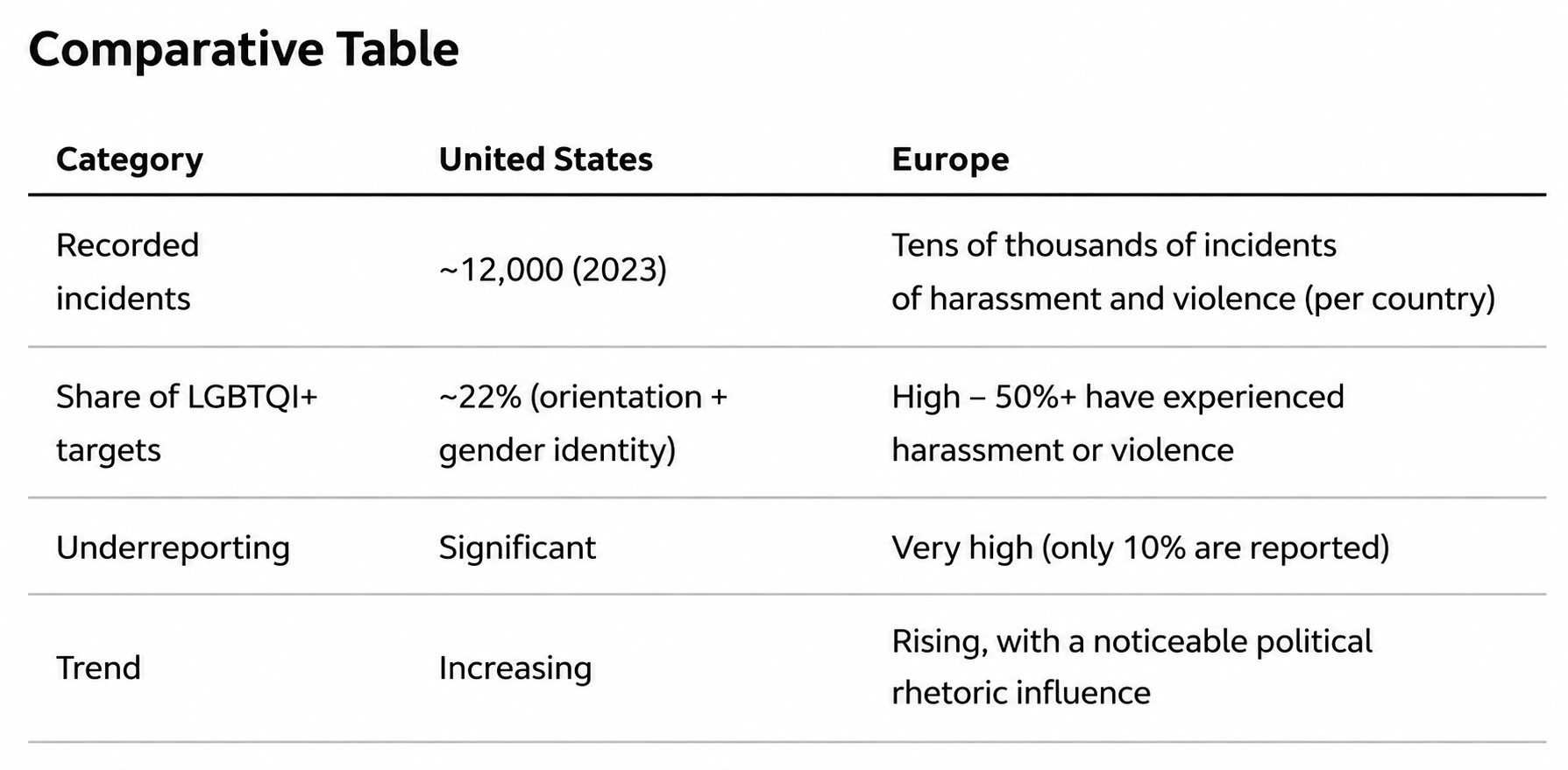
- 11,862 hate crime incidents were recorded, involving 13,829 offences and 14,416 victims.
- Most were motivated by race/ethnicity (approximately 52–53%).
- Crimes based on sexual orientation accounted for 18%, while those related to gender identity accounted for approximately 4%. - Reports indicate a general upward trend in recent years, while many incidents go unreported due to fear or distrust of the authorities.
At the same time, statistics from the European Union, based on data from the European Union Agency for Fundamental Rights (FRA), report that:
- 58% of LGBTQI+ people have experienced some form of harassment over the past five years.
- 11% have experienced a violent attack, rising to 17% among trans people.
- Only 1 in 10 incidents is reported to the authorities, indicating significant underreporting.
- Reports by PACE (Parliamentary Assembly of the Council of Europe) refer to increased hate speech by politicians and the media, creating a climate of fear.
Psychological Dimension
Research in social psychology shows that continuous exposure to hate speech can lead to:
- Normalisation of violence: When rhetoric portrays groups as “threats”, audiences may become more accepting of violence against them.
- Activation and mobilisation of individuals or extremist spaces: People who already hold aggressive tendencies or radical beliefs may move towards action.
- Secondary effects: Increased fear, anxiety, and restrictions on the freedom of expression of targeted groups.
In addition, specific peer-reviewed studies (e.g. Dancygier et al., 2022, American Political Science Review) document that #hatecrimes increase significantly in areas experiencing higher levels of hate speech in the media or even originating from politicians.
Nemesis and Catharsis – Social Reaction
Psychologists and sociologists such as Jonathan Haidt and James Gilligan have analysed the phenomenon of “catharsis” and social “nemesis” as a natural response to those who cause intense social pain. Although violence is not justified, society often perceives the death of a person who caused deep polarisation as a form of “symbolic justice”. This perception helps the masses restore a sense of balance, but it also carries the risk of justifying further cycles of violence.
Social Media Reactions and Political Analysis
Following Kirk’s death, social media were flooded with reactions ranging from light-hearted celebration to intense criticism of the tone of the discussion. Kirk’s supporters spoke of politically motivated violence and raised the issue of restrictions on freedom of speech. On the other hand, activists and LGBTQI+ organisations stressed that his rhetoric had been dangerous and that the discussion should focus on protecting minorities from speech that could lead to violence. Political analysts pointed out that his assassination would intensify political polarisation, potentially turning him into a “martyr” for the far right, which could strengthen the influence of the rhetoric he promoted. The debate surrounding the event highlighted the need for more responsible public discourse, but also for an understanding of how societies respond to figures considered sources of hatred.
“Hate Does Not Wear a Halo”
The assassination of Charlie Kirk cannot and must not become an occasion for his glorification. Turning a person who built a public discourse around targeting, disinformation and division into a “martyr of free speech” is a dangerous distortion of reality itself. Hate speech is not an opinion; it is a weapon. And when it is treated as merely an “opinion”, it is strengthened and reproduced, paving the way for new cycles of violence.

We have seen similar phenomena before: Anders Behring Breivik, who massacred dozens of young people on the island of Utøya, found admirers who honoured him as a “fighter for the nation”. Kyle Rittenhouse, an armed teenager who killed protesters, was elevated by far-right circles as a “patriot” and a “model of courage”. Even Ashli Babbitt, who was killed while storming the U.S. Capitol on January 6, was honoured as a “martyr” by followers of the conspiracy narrative surrounding the Storming of the United States Capitol. In each of these cases, society was confronted with a dangerous inversion of values: perpetrators and carriers of hate and violence appear as “victims” or “heroes”, while their actual targets — democratic institutions, human rights, and minorities — are silenced.
Freedom of speech is a foundation of democracy, but it is not a licence to spread poison.
Protecting it does not mean tolerating the incitement of hatred. On the contrary, condemning hate is the only way to protect freedom, because without respect for human dignity, there is no room for any freedom. Treating Kirk’s death as an occasion for glorification means legitimising the very hatred that poisons public discourse. And that is not honour — it is complicity.
Breaking the Cycle of Hate: From Rhetoric to Institutional Responsibility
Hate speech is not merely dangerous at the level of public discourse. It is connected to real-world attacks and psychological consequences for targeted groups. Journalists and analysts have a responsibility to demonstrate the links between public statements, social trends and statistical evidence.
Kirk’s case reminds us that violence can also turn against those who fuel it through their rhetoric. Although we do not celebrate anyone’s death, we must examine how society reacts to such figures and work to break the cycle of hatred before it produces new victims.
Proposal for Institutional Interventions
Education in schools on recognising and addressing hate speech, combined with awareness policies on human rights and diversity, can significantly reduce the normalisation of intolerant attitudes. Countries such as Sweden and the Netherlands have incorporated anti-hate educational programmes into their school curricula, while Germany invests in initiatives addressing far-right radicalisation. At the same time, strengthening mechanisms for reporting and prosecuting hate crimes, as implemented in the United Kingdom, has led to increased reporting and better protection for victims.
In Greece, a first-class opportunity to introduce hate-speech prevention education in a school setting came through a recent initiative implemented in cooperation with the Hellenic College and our European platform, Hate2HateEU. The programme aimed to raise awareness among students and young adults about hate speech through workshops, discussions and educational material designed to highlight the effects of fanaticism both online and in public spaces. The initiative served not only as an educational intervention, but also as a space for bringing together different experiences and ideas, fostering critical thinking and empowering young people to recognise and actively resist intolerant and hateful discourse.

Alexandros G. Tanaskidis – Lampousnakis
Journalist
European Accredited Professional on Hate Speech
United Nations Volunteers Human Rights Ambassador


